
Editors’ Note by Kelley Moore RPP, FCIP and Tharini Prakash
Moving Towards Sustainable Development
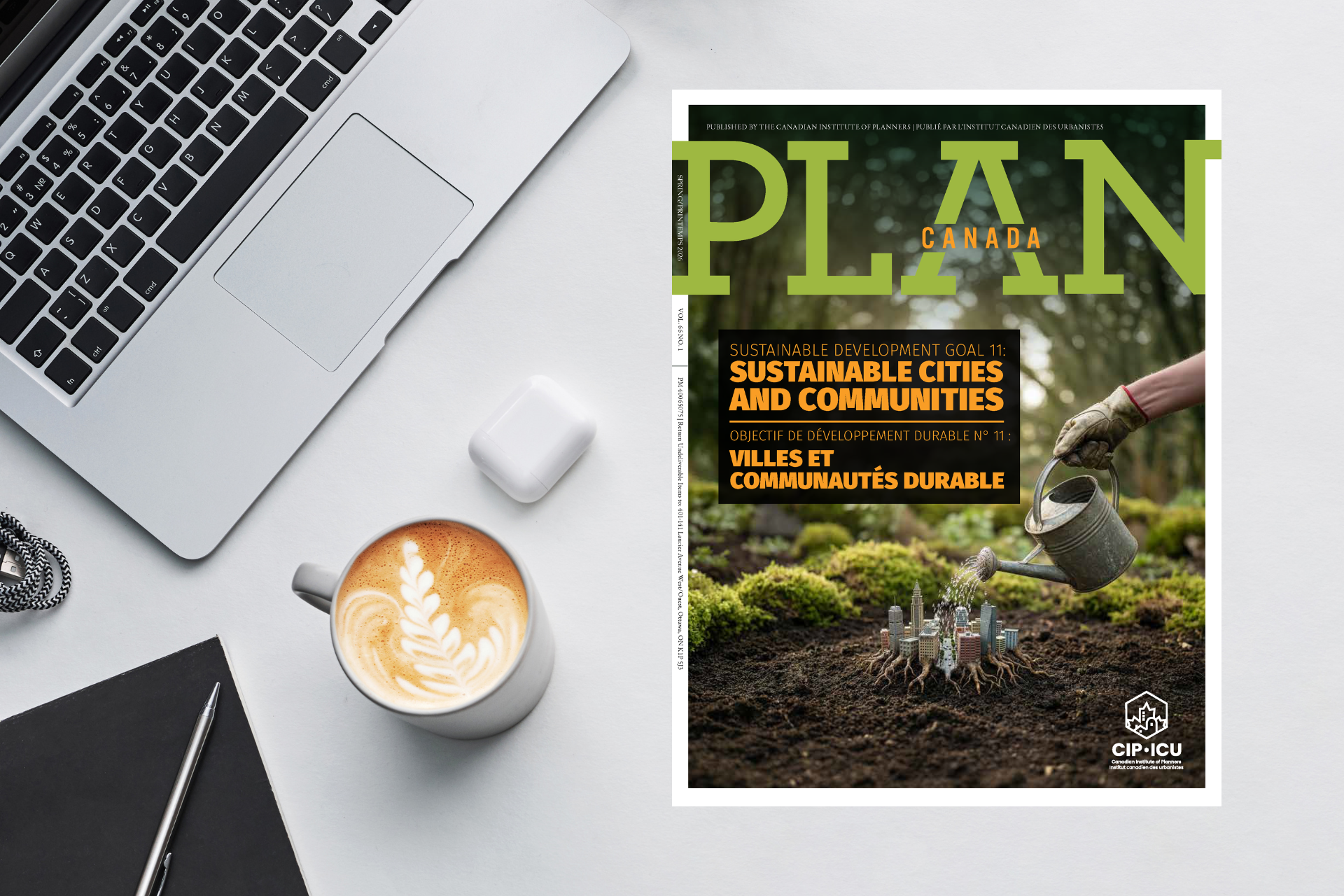
This special issue focused on the United Nations’ (UN) Sustainable Development
Goal 11 (SDG 11): Sustainable Cities and Communities. It offers a Canadian perspective on the global conversation to achieve this goal, aimed at inclusive, safe, resilient, and sustainable cities and human settlements.
In September 2015, Canada and all United Nations Member States adopted the 2030 Agenda for Sustainable Development (2030 Agenda). The SDGs form the framework of the 2030 Agenda, comprising 17 goals and 169 targets developed to guide countries, organizations, and communities toward a more sustainable future. SDG 11 comprises 7 targets.
This year, UN-Habitat will undertake a comprehensive review of several goals, including SDG 11. To coincide with this work, the Government of Canada is undertaking a nationwide review to inform the global review. This edition of Plan Canada offers insight into what planners are doing to advance SDG 11.
Mobilising SDG 11 in a rapidly changing global environment – through continued reporting, storytelling, and evidence from planners – is essential to demonstrating its value and relevance at the heart of planning. This issue draws attention to the underutilisation of the framework as a mechanism to help guide development. It further highlights the collective underreporting across varying levels of governance, academia and civil society, revealing the root challenges faced in mobilising the global goals at the local level – challenges that span shared responsibility across stakeholders and contexts, especially when the reporting is voluntary and non-binding. The symbiotic relationship between the local and global scales demonstrates interdependencies, the value of knowledge exchange, and the importance of understanding successful contextual approaches.
The shared knowledge gap is echoed in the United Kingdom context, highlighting the responsibility of planners on the sharp end of implementation, and the need to build a global library of resources. This includes bridging dialogue with educational institutions to help plan communities and develop scalable models through innovative ideas.
Indigenous planning, which inherently reflects the framework of SDG 11 and is grounded in the United Nations Declaration on the Rights of Indigenous Peoples (UNDRIP), opens dialogue on commemorating the Mi’kmaw and Urban Indigenous Heritage and on rights-based sustainable planning. The Mississaugas of Scugog Island First Nation–Durham Region Bilateral Agreement, signed in July 2025, highlights a relationship-based approach to co-developing communities through collaboration. It further reflects the deeper understanding that sustainability requires meaningful exchanges and tangible local actions. Intergenerational knowledge of the lands and waters is noted in the Nation-led Chemawawin Environmental Management Plan (EMP), where culture, climate adaptation, and resource-efficient policy converge.
Another unique lens discussed on sustainably planning Canadian communities is the fastest-growing aging demographic, particularly when safe, affordable and inclusive housing is considered. Diverse and efficient land use and mobility were key considerations in promoting autonomy, belonging, and wellbeing in later life.
This collection of articles signals a shift in planning perspective by exploring innovative local initiatives, partnerships, planning tools, and policy approaches that embody the spirit of our shared global vision and help inform the United Nations’ global review of SDG 11.
This issue highlights multiple pathways for Canadian planners to engage and advocate at a global scale, while continuously improving local plans and systems in a rapidly urbanising world.
How to Read This Issue of Plan Canada
Are you a CIP member?
Not a CIP member?
About the Editors

Kelley Moore RPP, FCIP, Secretary General & Trustee, Commonwealth Association of Planners
Kelley Moore, RRP, FCIP, integrates public policy, planning, and innovation. As VP at Innovation Saskatchewan, she leads research and technology park strategy. She also serves as Secretary General of the Commonwealth Association of Planners, advancing global collaboration and sustainable development.

Tharini Prakash, Planning Technician, Regional District of Okanagan-Similkameen
Tharini Prakash is an architect-turned planner, working with the Regional District of Okanagan-Similkameen. Based in Western Canada, she advances sustainable growth through local government policy, reconciliation planning, and large-scale development.