
By Deborah Morrison, CEO, Canadian Institute of Planners (CIP)
After seven months of immersing myself in the world of planners, the Canadian Urban Institute (CUI)’s State of Canada’s Cities Summit was my first major foray out into the broader ecosystem of urban leaders. Now in its third year, the Summit brought together hundreds of urban professionals, policymakers, business leaders, community advocates, and academics to shine a light on the city-building policies and innovations that are working and identify opportunities to scale them together.
This year’s theme, “Better Places for a Better Canada: Leveraging the Local,” united attendees with a vision of stronger, more resilient communities and a determination to collaborate on building a stronger national economy. I encourage you to check out the recordings, which will be posted on CUI’s website soon.
Until then, here are some of my personal observations and key takeaways for planners and community future-proofers.
Place-Based Solutions and the Speed of Trust
The overwhelming message from the Summit was clear—we need to focus on place-based solutions. Every community is different, and the only way to unlock the creativity and ingenuity of its citizens is to fully engage them in planning processes.
Engagement only moves as fast as trust. Trust between residents and institutions. Trust across jurisdictions. And trust in transparent, inclusive, and responsive processes. While building faster is a top priority across all levels of government right now, especially when it comes to increasing housing supply, there must first be a focus on building trust within our communities.
Small Communities, Big Challenges
Also notable was the Summit’s focus on the experience of smaller and rural communities. Discussions throughout the day emphasized the need to identify solutions that work for smaller municipalities that are experiencing the same housing and infrastructure pressures as large urban centres. Particularly, there is a critical need to ensure liveable communities for Indigenous peoples both on- and off-reserve.
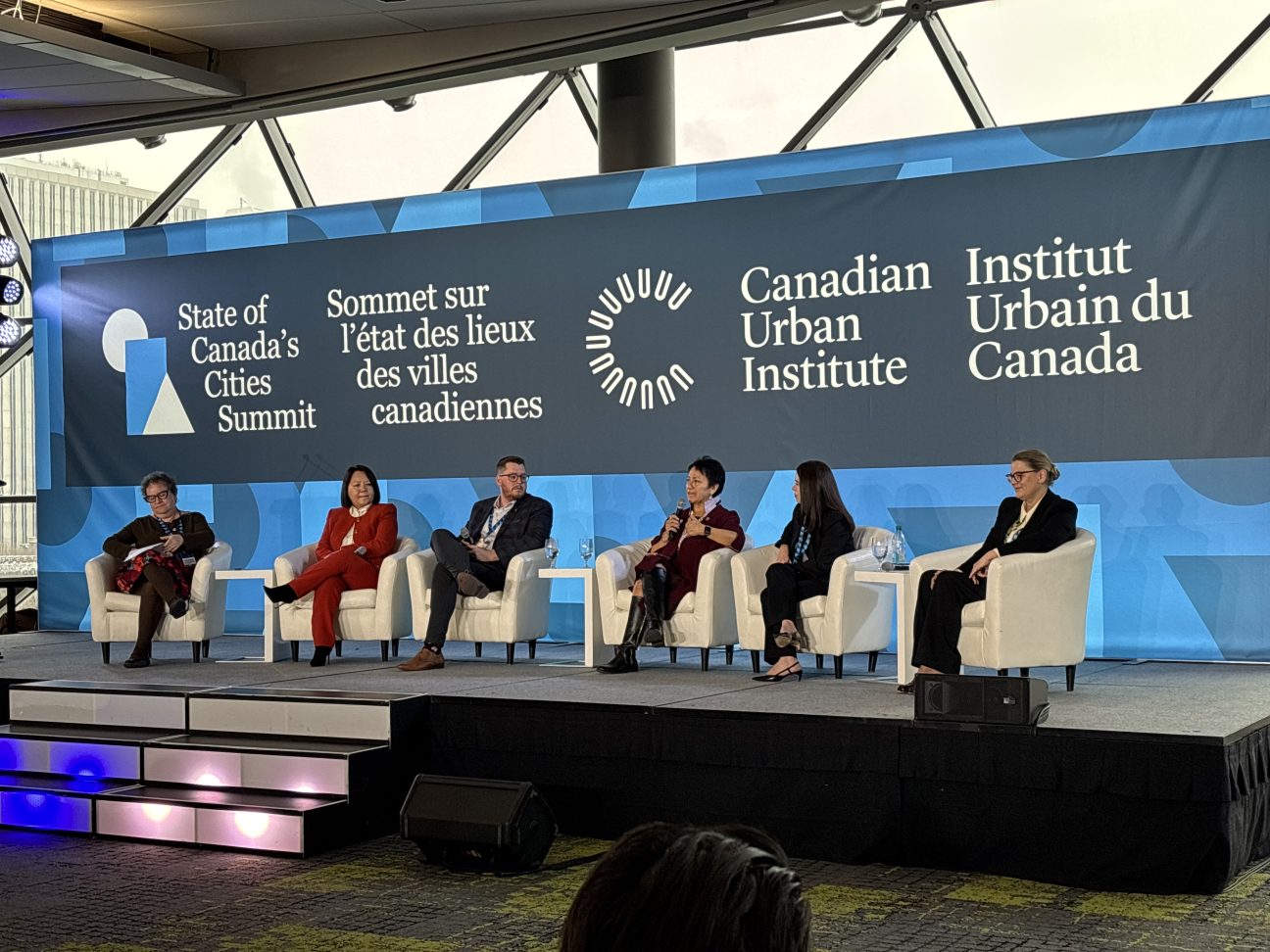
Second Photo: Carolyn Whitzman (Senior Housing Researcher and Adjunct Professor, School of Cities, University of Toronto), Tsering Yangki (Executive Vice President, Real Estate Finance and Development, Dream Unlimited Corp.), Brandon Searle (Director of Innovation and Operations, University of New Brunswick Off-site Construction Research Centre), Margaret Pfoh (Chief Executive Officer, Aboriginal Housing Management Association), Stephanie Shewchuk (Director, Housing Policy, Royal Bank of Canada), and Deana Grinnell (Executive Vice President, Real Estate, Canada Lands Company)
Moving Beyond Either/Or Thinking
Former Toronto Mayor David Miller discussed growing malaise over economic and environmental interests “colliding.” The reality is clear—Canada cannot afford to choose between economic growth and climate resiliency. We must stop thinking about solutions in terms of “either/or” when both are essential to the long-term sustainability of our communities. We all know what needs to be done, we know the urgency, and we can’t be intimidated by the complexity of the problem.
Technology and Innovation
Technology was also a featured topic throughout the day, with insightful presentations on how AI can help inform decision-making regardless of community size or the problems they are trying to solve, and how datasets can now be aggregated to support all aspects of planning. Uniting several of these conversations was the belief that we must persuade decision-makers to look beyond GDP to evaluate the strength of a community and to improve the measurement of what have typically been seen as intangible growth assets.
“Lightning talks” were also peppered throughout the day to showcase initiatives that were truly inspirational, such as:
- The Natural Assets Initiative, which has developed a way of measuring nature as an infrastructure asset;
- The Mass Culture project that is helping arts organizations quantify their contribution to better community outcomes; and
- The mobile community support service offered by the United Way of Bruce-Grey County.
The Hard Question: How Do We Pay for It All?
The end of the day gave space for big ideas on how to pay for all of this. The consensus was that we would not be able to make progress in addressing community needs until there was a new fiscal framework that delivered more resources to municipalities that carry the largest share of the load.
Zita Cobb, founder of the Shorefast Institute, drove this point home during her presentation on the economics of place. She advocated that the Canadian economy depends on an equitable balance between markets (institutions), governments, and places (communities). Right now, markets are a disproportionate driver in the economy, but innovation and creativity happen in places, and you cannot have growth without them. Places, she suggested, are undervalued by markets that are most often looking to extract rather than regenerate their returns on investment. Places are also frequently untapped by governments whose policies advance the status quo, even as communities thrive on their uniqueness. As a result, she claims that 90% of Canadian communities are “stranded assets,” and it is our job to restore that balance and unleash those assets.
These themes of livability, affordability, sustainability, and equity are nothing new to planners. In fact, all these issues were central to the work of our National Policy Working Groups and led to CIP’s recommendations for the 2025 federal budget. It was uplifting to be surrounded by those working outside the planning profession who shared the same vision and values and were also dedicated to finding new ways to build better communities. The day left me feeling inspired and wondering what more CIP and planners can do to advance this agenda. If you have any thoughts, please reach out to our team! We have a brand-new housing education initiative coming in the new year that we hope will equip planners with the up-to-date knowledge and resources they need to respond to this “hinge moment” for Canada’s urban places.