
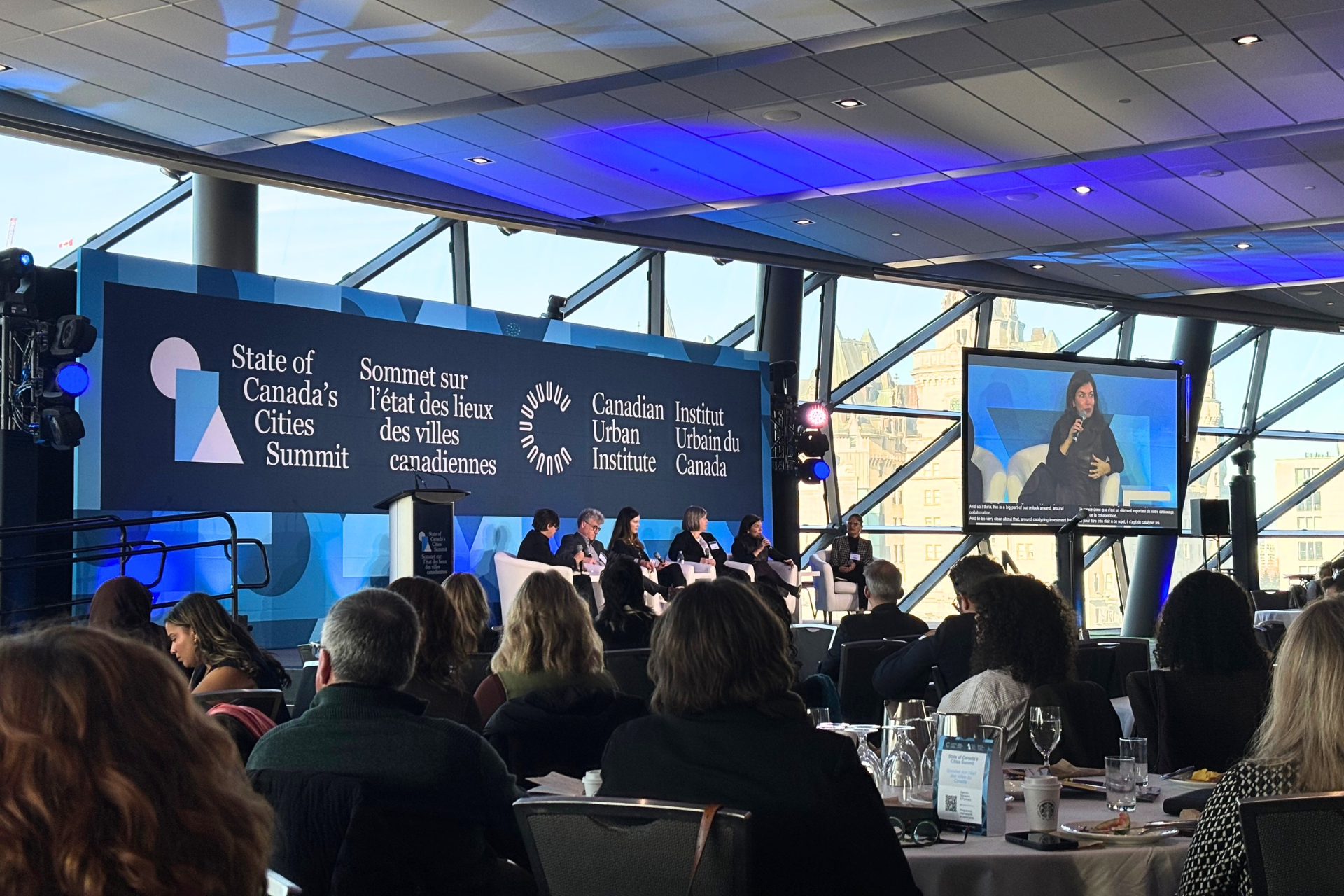
On November 12 and 13, the Canadian Urban Institute (CUI) brought together over 500 urban professionals, policymakers, municipal leaders, business representatives, and community advocates for the 4th annual State of Canada’s Cities Summit.
This year’s theme, Leveraging the Local, invited attendees to consider how local solutions, partnerships, and community knowledge can help advance Canada’s broader economic and social ambitions.
Across the two days of discussions and workshops, one message stood above the rest: Canada’s ability to achieve national ambitions depends on the strength of local communities.
Municipal Capacity to Deliver
A major focus of Day 1 was the disconnect between Canada’s housing and infrastructure goals and the capacity of municipalities to deliver them.
In the opening session, “Ready to Build: A National Urban Investment Policy for Canada,” representatives from the Royal Bank of Canada (RBC), the Federation of Canadian Municipalities (FCM), ARUP, the National Infrastructure Council, and Ville de Gatineau highlighted the need to move beyond funding announcements toward practical execution. While there is a significant appetite for investment in Canadian infrastructure and economic development, municipalities lack the resources, consistent revenue streams, and industrial capacity needed to turn ambitions into reality.
Housing growth relies on supporting infrastructure like wastewater treatment, transit, and energy. Yet municipalities are often expected to scale up these services without adequate funding or meaningful involvement in decision-making. At the same time, local governments are increasingly managing complex social needs that fall outside their traditional mandates, often while navigating siloed grant programs and competing priorities. This challenge extends beyond housing. Municipalities are increasingly finding themselves responsible for addressing complex community needs beyond their typical mandates, often while navigating overly specific funding programs and competing priorities across governments.
To fix this, Summit participants called for a renewed municipal fiscal framework, something CIP has advocated for in the past. Such a framework would be built on:
- Greater local control over finances and program design
- Predictable operational funding
- Stronger partnerships across federal, provincial, territorial, Indigenous, and municipal governments
For planners, the takeaway is clear: effective planning goes beyond identifying what communities need. It requires ensuring that local institutions tasked with building those solutions have the capacity to deliver.
Growth Beyond Major Infrastructure
Economic development was another prominent theme, with the launch of Main Street Canada & CUI’s shared tool, the “Main Street Economy Index,” and discussions highlighting the importance of looking beyond major projects and traditional measures of growth.
One standout session, “Enough is Enough: Strong Downtowns, Culture and the Future of Public Life,” highlighted how strong downtowns punch well above their weight in driving a city’s broader economy. Beyond commercial activity, they also contribute to community identity, belonging, safety, and the overall urban experience.
As the federal government pursues an ambitious economic agenda, major capital projects alone won’t guarantee success. Thriving communities rely just as heavily on the public realm—from main streets, local businesses, arts and culture, recreational facilities, and public gathering spaces. These elements are not secondary perks – they are foundational assets that attract residents, visitors, and jobs.
For decision-makers, the takeaway is clear: placemaking is an economic strategy. Effective growth requires looking not just at where major investments are directed, but also at the quality of the daily environments that make people want to invest their lives and businesses there.
Shaping Complete, Equitable Communities
The Summit also highlighted the importance of adopting a more comprehensive approach to community development, especially given the interconnections among housing, transportation, climate resilience, and social infrastructure.
Discussions on climate resilience emphasized that smaller and rural communities face many of the same pressures as major cities but are frequently overlooked by policies designed with urban centres in mind. Protecting and adapting these homes in the face of increasing hazards is critical, as they often provide some of Canada’s most affordable housing.
Other sessions examined the trade-offs of transit-oriented development. “Planning for People: Understanding Community Needs Amid Major Transportation Projects,” a workshop which included a case study on Toronto’s Finch West LRT illustrated how residents of the Jane and Finch neighbourhood feared the new transit line would price locals out and threaten vital community assets. In response, a community-led advocacy initiative stepped in to challenge systemic inequities, identify gaps in the original plan, protect key gathering spaces, and secure residents a meaningful voice in shaping their neighbourhood’s future.
For city builders, the takeaway is clear: social infrastructure must be planned with the same level of importance as physical infrastructure. Data can guide decisions, but it can never replace community knowledge and lived experience.
The Human Cost of Waiting: Who is Getting Left Behind?
One of the most important moments of the summit was a five-minute “lightning chat” that challenged attendees to consider one vital question: Who bears the real costs while we wait to build?
Much of Canada’s housing conversation rightly focuses on increasing supply, accelerating approvals, and attracting investment, but as institutions focus on fiscal numbers, the speaker reminded us not to lose sight of the people experiencing the sharpest consequences of the crisis.
Pointing to recent Toronto food bank data, the debate highlighted how housing insecurity intersects with systemic racism and other inequities, noting that renters, women, and people with disabilities are disproportionately represented among those facing food insecurity.
Ultimately, the cost of building cannot be measured solely in construction budgets, timelines, or investment returns. We must also weigh the human cost of delays, inaction, and displacement, and embed equity, accessibility, and meaningful community engagement from day one.
For our communities, the takeaway is clear: we must keep asking who benefits from new development, and who risks being left behind.
Looking Ahead
Throughout the Summit, themes and speakers were linked to a common challenge: Canada’s national ambitions cannot be achieved without stronger local partnerships. Whether discussing housing delivery, major infrastructure, municipal finance, or downtown revitalization, municipalities emerged repeatedly as indispensable partners, yet they are still too often left out of key decisions and expected to deliver results without the resources or authority to match.
Planners are uniquely positioned to bridge this divide. Through integrated planning, community engagement, and collaboration across sectors and levels of government, we, as a profession, can ensure that growth translates into meaningful improvements in the lives of all Canadians.