
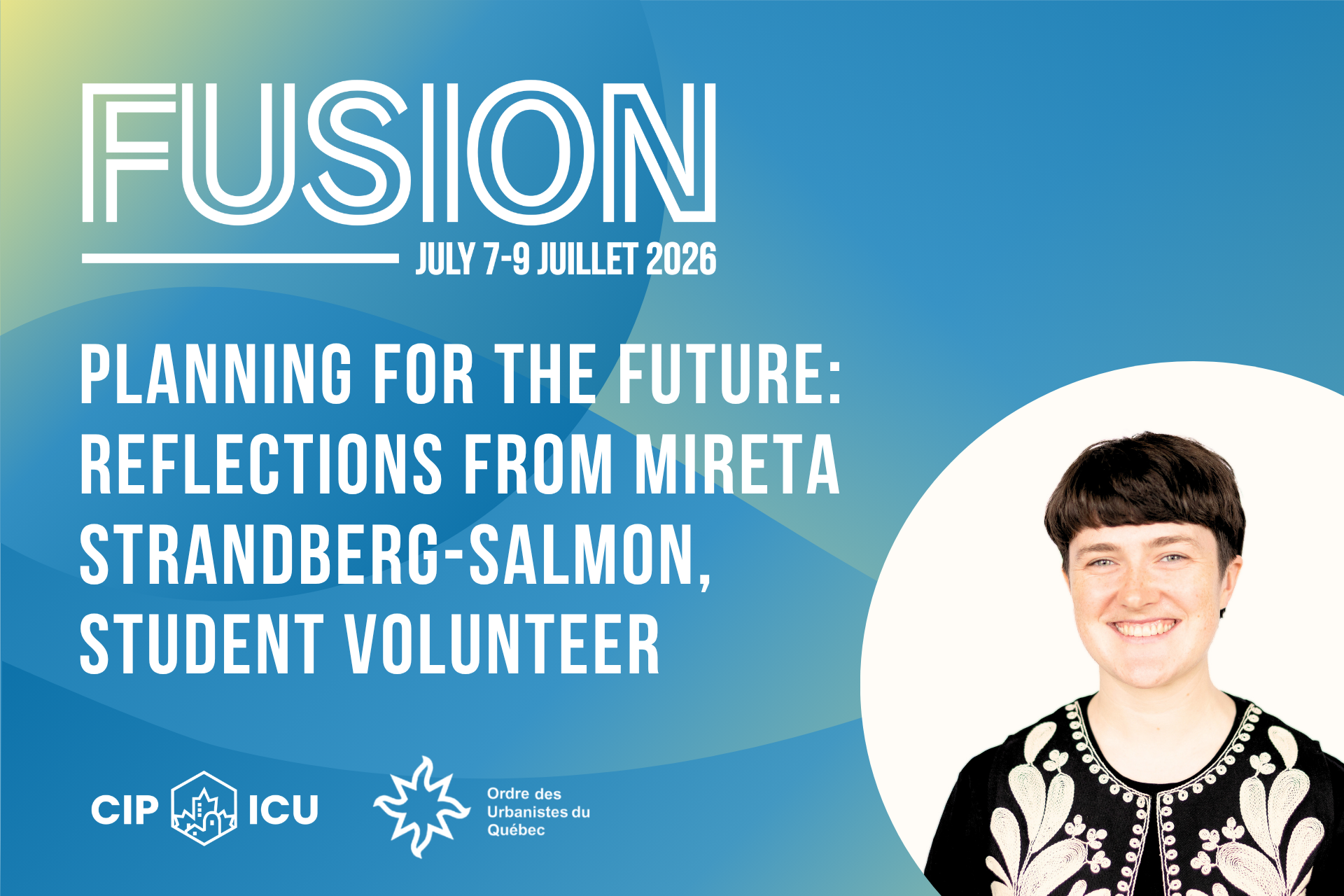
CIP and OUQ hosted FUSION 2026, Canada’s premier national planning conference, in Montreal from July 7-9, 2026. The conference would not have been a success without the support of our student volunteers and our student volunteer partner, the City of Calgary.
In this Q&A, we catch up with Mireta Strandberg-Salmon, a graduate student at the University of British Columbia’s (UBC) School of Community and Regional Planning, who shares highlights from the conference, lessons learned, and advice for fellow planning students.
Can you tell us a bit about yourself and why you decided to study planning?
I am passionate about building local climate resilience and advancing more sustainable and equitable futures. I have always wanted a career that advances climate justice and action, but I more recently discovered the important pathway that planning provides to creating those futures. Before beginning my studies in UBC’s Indigenous Community Planning program, I worked for 5 years as a policy advisor at Environment and Climate Change Canada and the Impact Assessment Agency of Canada. I advanced national policy development and consultation on big issues like carbon markets, circular economy, and cumulative effects, but I felt like people were missing from these top-down initiatives. That’s why I decided to study planning – so that I could help design climate solutions that put community at the centre.
What motivated you to volunteer at FUSION 2026?
I applied to volunteer at FUSION 2026 because it was an accessible way for me to attend the conference in Montreal, engage with the planning profession beyond the classroom, and contribute to the professional community I am joining. I volunteered as UBC’s CIP Student Liaison during the first year of my master’s. In this role, I learned about the range of opportunities that CIP offers to students and new professionals, including the conference. I was keen to learn more about CIP, meet CIP staff and delegates, and connect with other planning students from across Canada. I hope to continue building on the relationships I established with CIP colleagues and my peers as I look to launch my planning career.
Was there a memorable interaction with a delegate, speaker, or fellow volunteer that stood out to you?
My biggest take-away from FUSION 2026 was a sense of pride. I felt so proud to be part of a profession that is taking major social and environmental crises seriously – from climate change to housing affordability to mental health. By engaging in conference topics such as meaningful youth engagement and decolonization, I felt empowered knowing that the planning profession shares my ambitions to make our communities better places for everyone. In particular, I was excited to learn about Heather Swan’s work to support the creation of an Indigenous planning association at the national scale.
What does being a part of the planning community mean to you, and how did this conference influence that at all?
Volunteering at FUSION 2026 felt like my official initiation as a new member of the planning community. I felt welcomed and valued in the discussions that I was part of with more experienced planners. It was especially fun to be part of the festive community building at the Masquerade Ball. The conference made the planning world feel both big and small, and I look forward to reconnecting with FUSION participants again soon, whether at Momentum 2027 in my home province or in the workplace when I graduate next year!
Do you have any advice for other planning students considering volunteering at future conferences?
I strongly recommend volunteering at future CIP conferences, especially if it is your first time attending! I wasn’t nervous about attending FUSION 2026 even though it was my first time because I knew the CIP team and the other students were there to support me throughout the experience. It’s a great way to get more involved in the planning profession at the beginning of your career, and experience a new city if you’re travelling from afar. My favourite volunteering role was scanning delegate badges because it gave me the opportunity to connect with so many people from across Canada, and I still had time to participate in other CIP offerings such as the Resume Clinic and professional headshots.
Is there anything else you’d like to share with CIP members?
The compounding crises affecting societies, ecosystems, and economies worldwide can be overwhelming, particularly for young students, and I know planners are working hard to do their part to address these wicked problems. In this context, it’s important to come together to celebrate wins and build community, because we’re in it for the long haul. CIP did a great job of that at FUSION 2026 – while I learned a lot during the keynotes, workshops, and panel sessions, my most memorable experiences were at the Max Bacon Run and the Masquerade! I didn’t know planning could be so fun.
Want to get more involved in the planning community?
Join CIP as a student member for free! As a student member, you’ll gain access to volunteer and networking opportunities, events, and the latest planning news to help you grow your career from day one.
About the Author
Mireta is pursuing a Master of Community and Regional Planning in Indigenous Community Planning at the University of British Columbia (UBC), where she is learning how to plan with – rather than for – communities. Through her Bachelor of Environment in Resource and Environmental Management and Dialogue at Simon Fraser University (SFU), Mireta organized and facilitated public dialogues on the climate emergency, sparking her interest in inclusive engagement as a theory of change. As part of Mireta’s environmental leadership, she co-founded and led Ban the Bottle SFU from 2018-2021, successfully mobilizing the university to eliminate bottled water. She served as UBC’s CIP Student Liaison from 2025-2026, and she will serve as the UBC Student Representative on the Board of the Planning Institute of BC from 2026-2027.