
Each year, CIP’s Emerging Planner Award recognizes a professional within the first 10 years of their planning career who is already making a meaningful impact in the profession.
At FUSION 2026, held in Montreal from July 7 to 9, Armi De Francia received this honour in front of peers, mentors, and leaders from across the country.
Congratulations on receiving CIP’s Emerging Planner Award! What was it like to be recognized at FUSION 2026?
As a graduate from the McGill School of Urban Planning, winning this award has been a full-circle moment for me. It was incredible to be recognized in the city where my Planning journey began. I am truly grateful for the many meaningful and joyful connections that this journey has brought me, both in Montreal and beyond. It was also really cool to meet Neil Loewen and hear about his exciting work in development and academia!
What does the Emerging Planner Award mean to you at this stage in your career?
For me, this award is a recognition of leadership and courage in the planning profession. Throughout the years, I took a lot of initiative to address systemic (colonialism, car-dependency) and even personal challenges (insecurities, grief, caregiving) to get where I am now.
Despite many moments of rejection, I implemented numerous equity initiatives by finding collaboration and funding opportunities. Two skills that got me here were learning how to build relationships across differences and how to use conflict to deepen our understanding of the public interest and enrich collaboration. This award represents my journey of responding to “wicked problems” through messy learning amidst imperfect conditions.
Can you tell us about your experience attending FUSION 2026?
What I found most meaningful was learning about different ways that municipalities across Canada are approaching truth and reconciliation. From the keynote presentation to sessions about witnessing and additions to a reserve, it was helpful to see what positive nation-to-nation relationships and collaboration could look like.
I also found the Working Framework to Plan With and For Black Communities by the Black Planning Project helpful for overcoming systemic anti-Black racism in past and current planning processes. I am hoping that the achievements and contributions of Black communities to city building will be taught in obligatory courses about Planning history.
How did the conference help you grow as a professional?
I learned a lot about leadership from the session about Witnessing: an accountability practice and coordinated approach between Comox Valley Regional District, K’omoks First Nation, and Sanala Planning. By explaining the Indigenous practice of witnessing, the speakers taught me the importance of interdepartmental and interjurisdictional coordination, listening to different types of knowledge, reflecting, and communicating results and updates. Speakers also taught me that resilience involves being able to “flow like water”, being able to keep moving around whatever comes our way. I look forward to practicing these insights on leadership and resilience as I continue growing in the planning profession.
What advice would you give to other early-career planners thinking about attending a future national conference?
There is only so much we can learn within our own bubble, whether that be our employer or our province. It’s worth attending a CIP conference to learn from municipalities across Canada and for experiential learning in a different province.
My biggest mistake was missing out on the many fascinating walking and biking tours. To make the most of the conference, I highly recommend signing up for at least one before spaces run out.
Looking back, what experience early in your planning career had the biggest impact on the planner you are today?
Studying in Montreal taught me to get out of my comfort zone, which has helped me tremendously with equitable community engagement. I was a young student leaving my nest in the Greater Toronto Area for the first time and I even challenged myself to learn more in a different language. My internship in a francophone environment involved engaging people with disabilities which later led to me engaging people with disabilities in a shared e-scooter and e-bike pilot program. My studio project for an Indigenous community in Northern Quebec challenged me to think beyond a colonial perspective which helped me initiate relationships between my current employer and Treaty First Nations communities. It was a humbling experience that got me to open up to a variety of perspectives on the public interest.
What’s next for you? Are there any projects or goals on the horizon?
I am currently working on helping my employer, a suburban municipality, achieve gold designation in the Bicycle Friendly Communities program. The leadership and interjurisdictional coordination that other Canadian municipalities have achieved inspire me to build on opportunities for strategic partnerships. I am also working on becoming a sustainable mobility speaker to inspire community champions to collaborate with municipalities in improving mobility choice.
Is there anything else you’d like to share with CIP members?
I would like to say a big thank you to everyone who I collaborated with and who shared their insights with me. Notably, thank you to my mentor, Jay Pitter, for nominating me for this award and for shaping how I practice planning. Early on, she taught me the importance of creating space for people to speak, especially those facing various forms of systems of oppression. This led me to create numerous opportunities for meaningful participation that included the voices of people with disabilities, racialized people, high school students, and many different people with different viewpoints. And now, she is inspiring me to share results and learnings and to work towards collective joy, something I encourage Planners to do as well.
Inspired by Armi’s story?
Nominations are now accepted for the Emerging Planner Award. Individuals may either self-nominate or be nominated by an employer, colleague, or CIP member. Award recipients are presented during the honours and awards ceremony at MOMENTUM 2027 in Victoria, BC.
About the Author
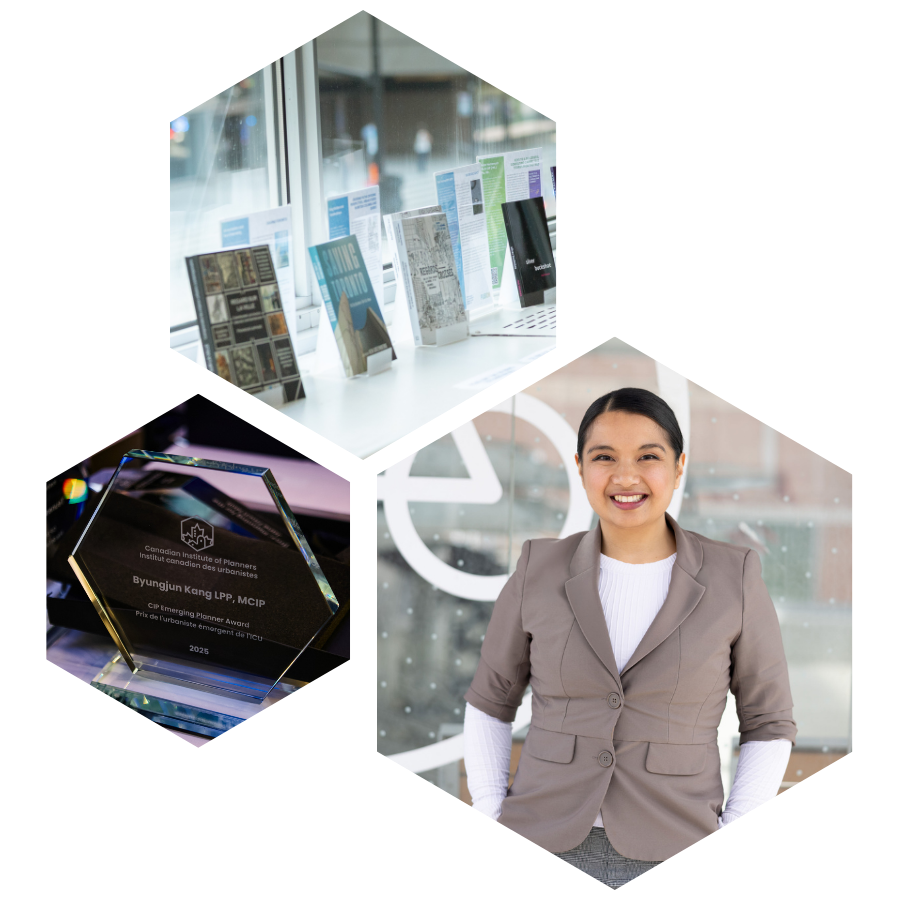
Armi De Francia RPP, MCIP is an award-winning active transportation planner and sustainable mobility speaker. She is dedicated to improving walkability and bikeability to increase access to opportunity, community, and environmental justice. For over ten years, Armi has contributed to active transportation projects in the GTHA and Montreal in the non-profit and public sectors. As the Active Transportation Coordinator at the Town of Ajax, Armi is responsible for implementing the Shared E-scooter and E-bike Pilot Program, on-road bike facilities, Transportation Demand Management Plan, cycling wayfinding strategy, and active school travel. Notable efforts to advance equity include the 2023 Transportation Demand Management Plan Update with a focus on equity, 2023 Woman of Colour Bike Ride, and ongoing significant engagement with people with disabilities in the Shared E-scooter and E-bike Pilot Program.