
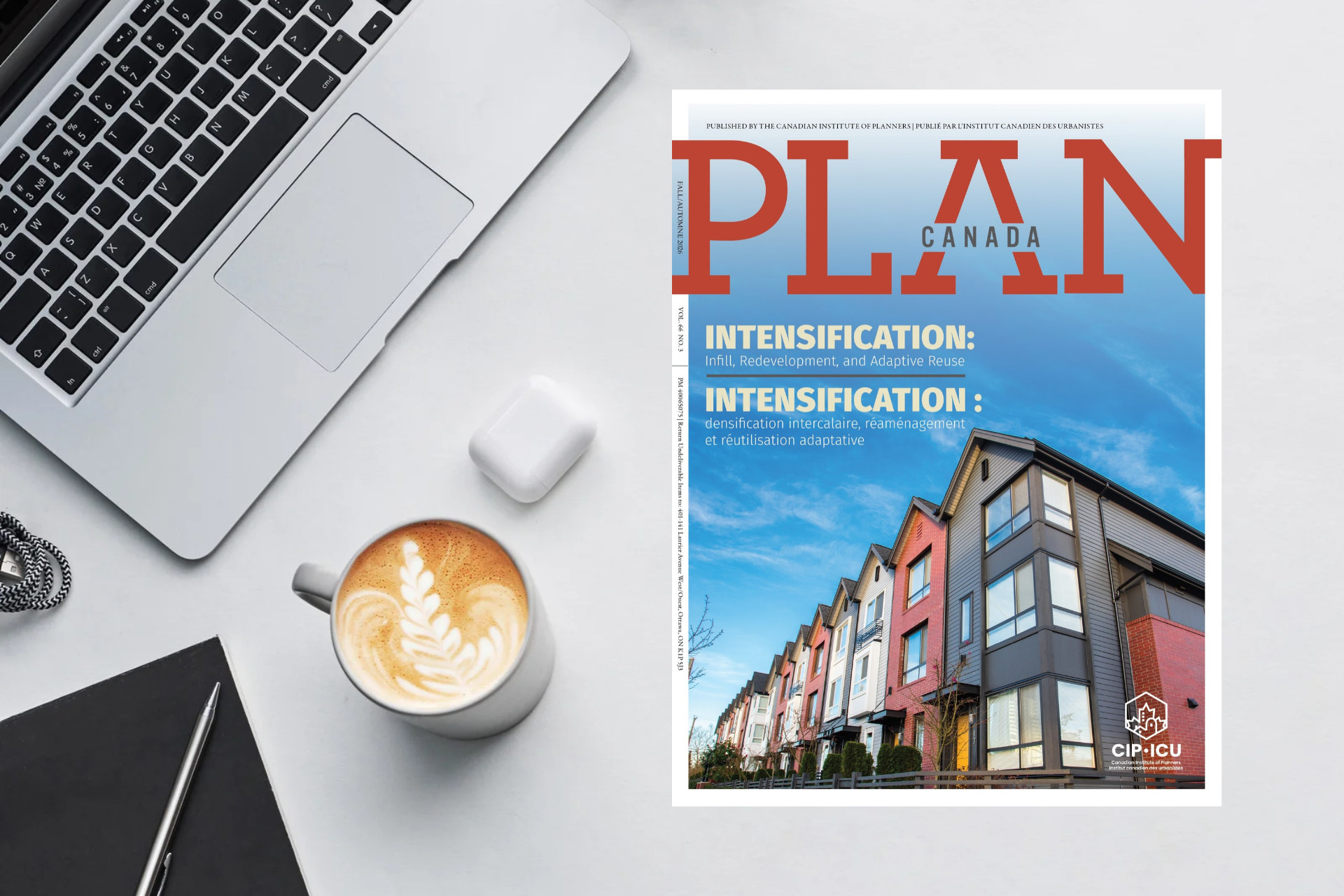
Editors’ Note by Rylan Graham PhD, RPP, MCIP and Ezra Wasser RPP, MCIP
Thinking Smaller, Thinking Big
As our communities continue to evolve, planners will remain central to shaping their future – including in guiding how and where we accommodate growth and development. Intensification has long been lauded as a sustainable alternative to the low-density, peripheral development that has dominated urbanization patterns since the 20th century. By directing growth towards mature neighbourhoods, intensification offers a clear pathway towards building the complete, compact, and connected communities that are envisioned in planning documents across the country.
And yet, implementing intensification-related goals, objectives, and policies is complex and not without its own set of challenges. Neighbours often contest new infill housing, redevelopment schemes raise serious questions around gentrification and displacement, and adaptive reuse projects frequently encounter regulatory and financial constraints. The case for intensification remains compelling, but translating its goals into practice is seldomly so straightforward.
The articles in this Fall edition of Plan Canada examine these tensions from a range of perspectives and contexts, considering both the opportunities intensification presents and the challenges of implementation.
Miller opens this edition by offering a brief overview on the underpinnings of the term ‘intensification,’ before going on to discuss two communities have developed from greenfield sites into mixed-use nodes. These experiences demonstrate both the possibilities and limitations of planned intensification.
Manhas and Chalmers assess the effectiveness of recent legislation introduced in British Columbia to unlock more small-scale, multi-unit infill housing. Their analysis offers a useful reminder that regulatory change is only one piece of the puzzle.
Toronto’s experience with intensification is shared by Stubbs, Naklicki and Weatherburn, who emphasize the importance of tools that move beyond what is legally permitted to consider what is financially feasible.
Several contributions turn our attention to the potential already embedded in the urban fabric. Wilson demonstrates how open data can help planners to identify opportunities for intensification, from vacant parcels to underused parking lots in walkable locations.
Turning to adaptive reuse in Winnipeg, Kowalke shares how existing buildings can be converted to residential uses – helping the community to deliver on a multitude of goals including improved access to housing, preservation of heritage assets, and the revitalization of mature neighbourhoods.
The climate implications of intensification are put into further context by Ngalle, who argues that adaptive reuse should be understood not only as a tool to preserve heritage buildings, but also as a necessary strategy in the face of climate change.
As intensification expands into new frontiers, Dunham shares that planners should proceed with caution, as new mixed- use development threatens to displace important employment lands. The article provides a framework for planners to consider when preserving industrial uses may be the more appropriate option.
Lessard’s research in the Greater Montreal Area finds complications in the relationship between planning ambitions and market realities. Despite metropolitan plans emphasizing transit-oriented development, their findings show that most new multi-unit residential buildings have been constructed on vacant land near highways and along the urban edge. The findings highlight the importance of understanding market behaviour – and of designing planning tools that can align those forces with broader regional objectives.
Finally, Calihoo and Rogers examine tiny homes as a more subtle form of intensification. Their discussion of Nova Scotia’s emerging regulatory approach illustrates how provincial and local governments can create the conditions for innovative housing forms while providing the clarity needed by communities, planners, and builders.
Collectively, these articles cast a wide net over intensification, exploring its various forms, impacts, and implications across contexts that span the country. They offer important insights into the opportunities and challenges that infill, redevelopment, and adaptive reuse present in the current context, while also inviting us to revisit longstanding discussions about how we accommodate growth in our communities.
How to Read This Issue of Plan Canada
Are you a CIP member? Log in to access your copy.
Not a CIP member? Become a subscriber!